
Interviewed by Meaghan Sullivan, Google Workspace Marketing Customer Programs Lead
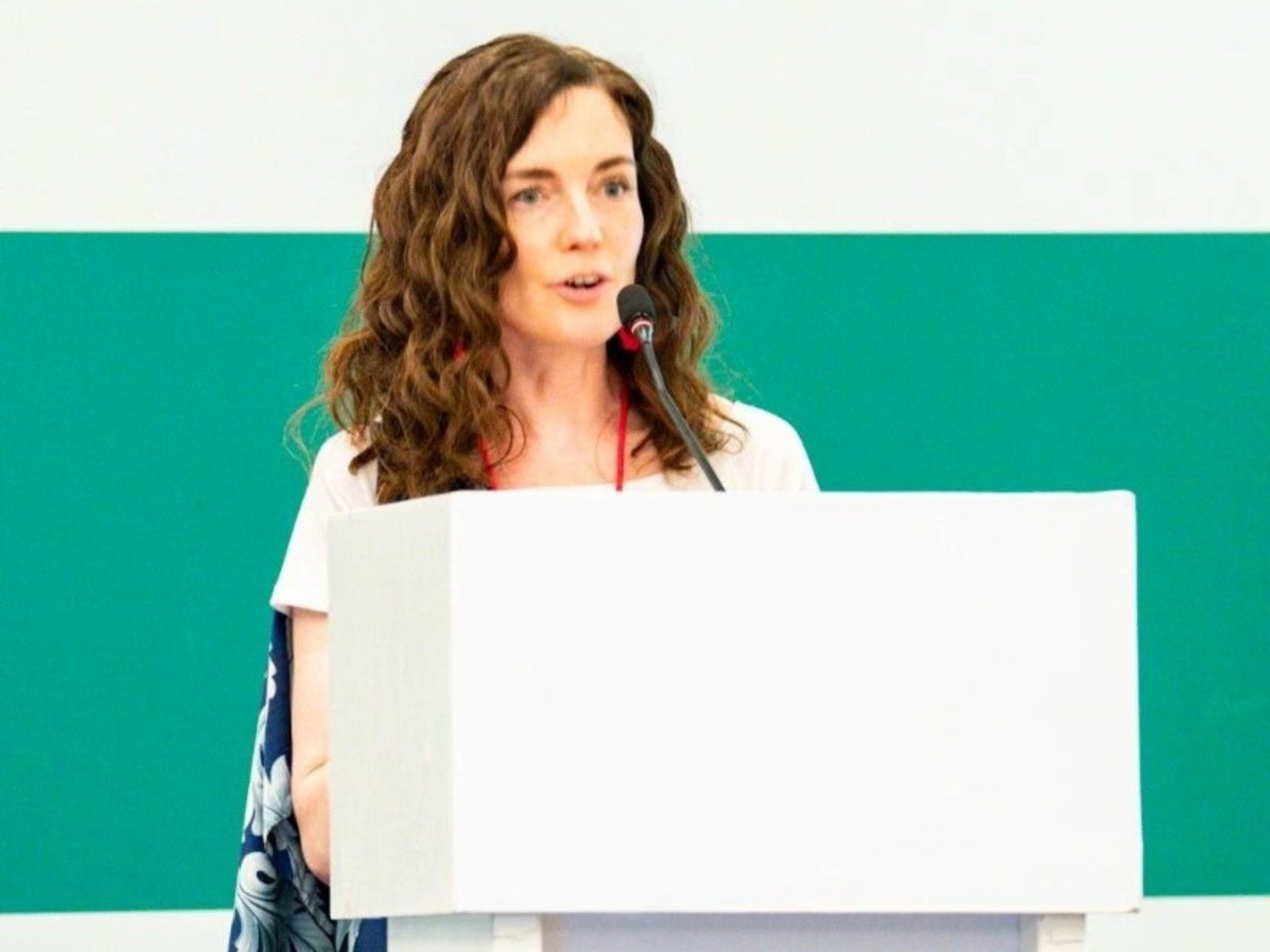
Ciara Commins is a Climate Justice Contract Manager and Founder of Reconnect and Recentre Coaching, a life coaching company dedicated to helping you connect to your natural cycles and transform with ease.
Ciara’s career has taken her all over the world from environmental engineering on tropical islands in Australia to working on disability inclusion projects in South Sudan. Ciara now lives in her native Ireland with her husband and two beautiful boys by the sea. She’s deeply connected to the land and loves nothing more than a sunrise sea swim with her little boys. She talks a lot about the power of the menstrual cycle and the Celtic Wheel of the Year!
Can you tell us the story of your first period?
My first period was when I was 14. I really wanted to have my period because other girls had it [already]. Then, when I got my period, all of a sudden, there was this silence about [menstruation]. It was positive in that I was very excited to get it, but then once I got it, I was like “Well, that’s kind of it. No one talks about it, you know, it’s kind of done.”
How were you taught about menstruation?
Oh, very very little. In primary school, I don’t remember [having] any kind of sex education. Secondary school was when I got my period, so we would’ve talked about it in biology. But I knew very little about it.
I think a lot of us have different experiences, especially depending on where we grew up, where we were born, and then even the generation that we’re in. Every single one of those factors impacts our education, especially when it comes to menstruation. What were some of the misconceptions that you had about periods?
I guess the big misconception was that [one’s period] is something to be hidden away and not really talked about. It was much later in life that I really got to understand how the cycle works. I just thought that you have a bleed every month and that’s it, but I didn’t know the other aspects of the cycle.
Yeah, it’s such an interesting thing. You probably see this a lot in the work that you do, but there are all these other elements that have an ongoing impact on one’s body. It’s so important that we can be more knowledgeable about what’s happening to us all of the time, and not just when we happen to be bleeding and need to use a period product. Now, this is a fun one: What is the first word that comes to mind when you think of menstruation?
Now, the word is power. I’ve discovered that women’s productivity is in a cycle of roughly 28 days, and men’s productivity is in a 24-hour cycle. So, our systems and structures are generally set up for a 24-hour, five-day working week. Whereas with women, our productivity and our power are in the 28-day cycle. What I find is that if you rest at specific times of your cycle, you are so energetic, and you’re able to boost that energy throughout the remainder of your cycle. I see [menstruation] as really empowering now.
Do you believe that periods should be discussed in the workplace? Why or why not?
Absolutely, periods should be discussed in the workplace. It’s good to know and to have that transparency because there are many physical impacts during [one’s cycle]. For example, if someone’s close to ovulation, they’re very energetic and ready to go. But if they’re coming toward their bleed, their inner critic is going to be heightened so they may take feedback a little bit more to heart. If they’re on their bleed, they may just need more toilet breaks. So talking about it is critical because it just shows the cycle of productivity for female bodies. It also makes you more effective as an employee or as a business owner because if you know where you are in your cycle and you’re able to be vocal about that, it just makes everything run more smoothly.
How do you think organizations can create a supportive and inclusive environment for employees to then talk about menstruation?
I’m a manager, and I think it does come from middle management and senior managers. The more managers embody it, talk about it, and be open about it, the better. I’ve had a female director, and now we have a female CEO. I think having someone [in a leadership position] go through similar experiences and being able to have those conversations really helps.
Do you think that there are any policies or initiatives that are essential for addressing menstruation-related challenges in the workplace?
I think it’s important that you have some kind of policy that encourages discussion and openness about it. We’re introducing a menopause policy, and that’s quite useful because the policy really encourages conversations between the manager and the employee. It’s also about the culture.
Are you seeing a generational shift in attitudes toward discussing the topic of menstruation in the workplace or even in our communities?
Yes, I would definitely say that I feel a shift. I’ll start with the community [aspect] first because I find there’s a lot more women’s circles forming, and I find them really empowering. Particularly in Ireland, there are old practices coming back. One of those practices is taking your [menstrual] blood, mixing water, and giving it back to the land which is quite a sacred practice. In the workplace, I would say it’s more of a youth movement coming through and being more vocal about a range of issues.
What advice would you give to someone who feels uncomfortable discussing their menstrual health needs⸺or menstrual health in general⸺with their employers or even their fellow colleagues?
I think the first thing would be to get to know your cycle better. The more you understand about your cycle, the more empowered you’ll feel. Then I would advise them to seek out someone that you feel would be a sympathetic ear. It can be someone in HR because they’re trained on things like this or another colleague. It is scary, and oftentimes, it can feel like it’s just us and us alone. But it’s important to remember that there are generations and generations of silence [on the topic of menstruation] behind us, and that’s what you’re coming up against.