

In 2024, Aunt Flow partnered with Flow Forward NJ to support research examining period poverty among college and university students and access to period products on campuses across New Jersey.
Led by Flow Forward NJ’s Research Director, Kathryn Seu, this study addresses a critical gap in existing research by centering the lived experiences of college students—a population often overlooked in national period poverty data.
New Jersey’s diverse higher education landscape provided a unique opportunity to better understand how limited access to menstrual products, education, and hygiene resources impacts students’ academic performance, mental health, and overall well-being.
Through a statewide survey with 614 student respondents, this research combines quantitative data with firsthand student perspectives to illuminate the prevalence of period poverty and the barriers students face on campus.
The findings from this study are intended to inform campus administrators, policymakers and advocates as they work to advance period equity initiatives and expand access to free menstrual products in higher education spaces.
Survey Research Methods and Distribution
The “Menstruation at NJ Colleges and Universities” survey was developed by Research Director Kathryn Seu, Executive Director Sarah McClure, and Education Director Pranita Sannidhi in consultation with our sponsoring company, Aunt Flow.
The survey was reviewed by Dr. Marybec Griffin of the Department of Health Behavior, Society, and Policy at the Rutgers School of Public Health. After rewriting and reviewing, the survey was ready for launch in February of 2024.
It opened on February 12, 2024, and closed on May 10, 2024, with distribution via social media, email, campus outreach, and tabling events in partnership with campus teams at Rutgers, Montclair, The College of New Jersey, Princeton, and Rowan University.
614 college students across New Jersey were surveyed to better understand:
- Access to menstrual products on campus
- Affordability challenges
- Impacts on academic performance and well-being
- Student perceptions and stigma around menstruation
What we found is clear: period poverty is widespread, and it’s affecting students far beyond the bathroom.
Key Findings
Period products aren’t affordable for many students
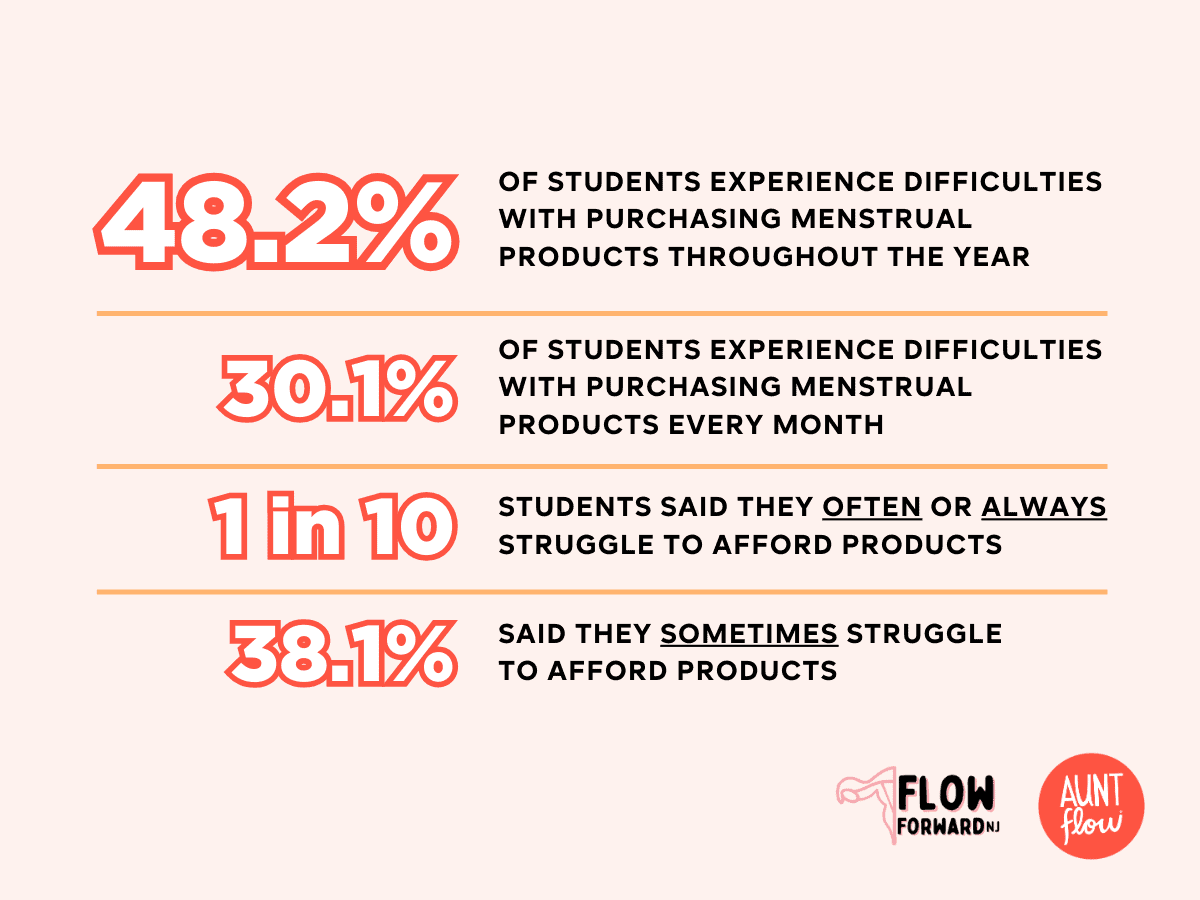
- 48.2% experience difficulty purchasing products throughout the year
- 30.1% say products are difficult to afford every month
- Nearly 1 in 10 struggle often or always
For many students, period products are not just an inconvenience. They’re a financial burden.
Period poverty is affecting academic success
- 32% say lack of access impacts their academic performance
- Over 1 in 3 students have missed class due to their period or lack of products
Access exists, but awareness is lacking
- 55.5% say their school offers free products
- But 32.4% aren’t sure if they’re available
- 11.7% say their school does not offer them
Even when resources exist, students don’t always know where to find them, leading to wasted time, stress, and missed opportunities for support.
In some cases, students reported spending 15+ minutes searching for products or not finding them at all.
Students overwhelmingly support free period products
This might be the most unanimous finding in the report:
- 97.8% believe period products should be free on college campuses

For most students, the reasoning is simple: period products are a basic necessity, just like toilet paper.
The Equity Gap: Who Is Most Affected?
The data also highlights important disparities.
- 57% of Black students reported struggling to afford products
- 37% of Asian students reported the same
- Students from lower-income backgrounds are significantly more likely to rely on free campus products
This reinforces a key truth: Period poverty is deeply connected to broader issues like income inequality and access to resources.
Stigma is changing, but it’s situational
There’s good news here:
- 69% say they are never uncomfortable talking about periods
- Most students believe conversations around menstruation are beneficial
But context matters, and embarrassment still poses a barrier. Students are more likely to feel embarrassed when:
- Asking strangers
- Speaking in mixed-gender settings
- Being unprepared in public situations
In fact, 18% have been too embarrassed to ask for a product.
Students shared stories of using toilet paper, isolating themselves, or avoiding class altogether due to lack of access and stigma.
I often have to wear products longer than I should because I can’t afford more… I spend those days in isolation.
Why This Matters
This research highlights a clear reality: Period poverty is not just a health issue; it’s an education and equity issue.
When students don’t have reliable access to menstrual products, it can impact:
- Attendance
- Academic performance
- Mental and physical well-being
And while some campuses have taken steps to provide free products, lack of awareness and inconsistent access remain major barriers.
Read the Full Study
👉 Read the full report to explore the complete data, student stories, and recommendations for advancing menstrual equity on college campuses.
Advocate for Aunt Flow on Campus
Want to help bring free period products to your campus?
👉 Advocate for Aunt Flow at your school and help create spaces where all students have access to the products they need, when they need them.