

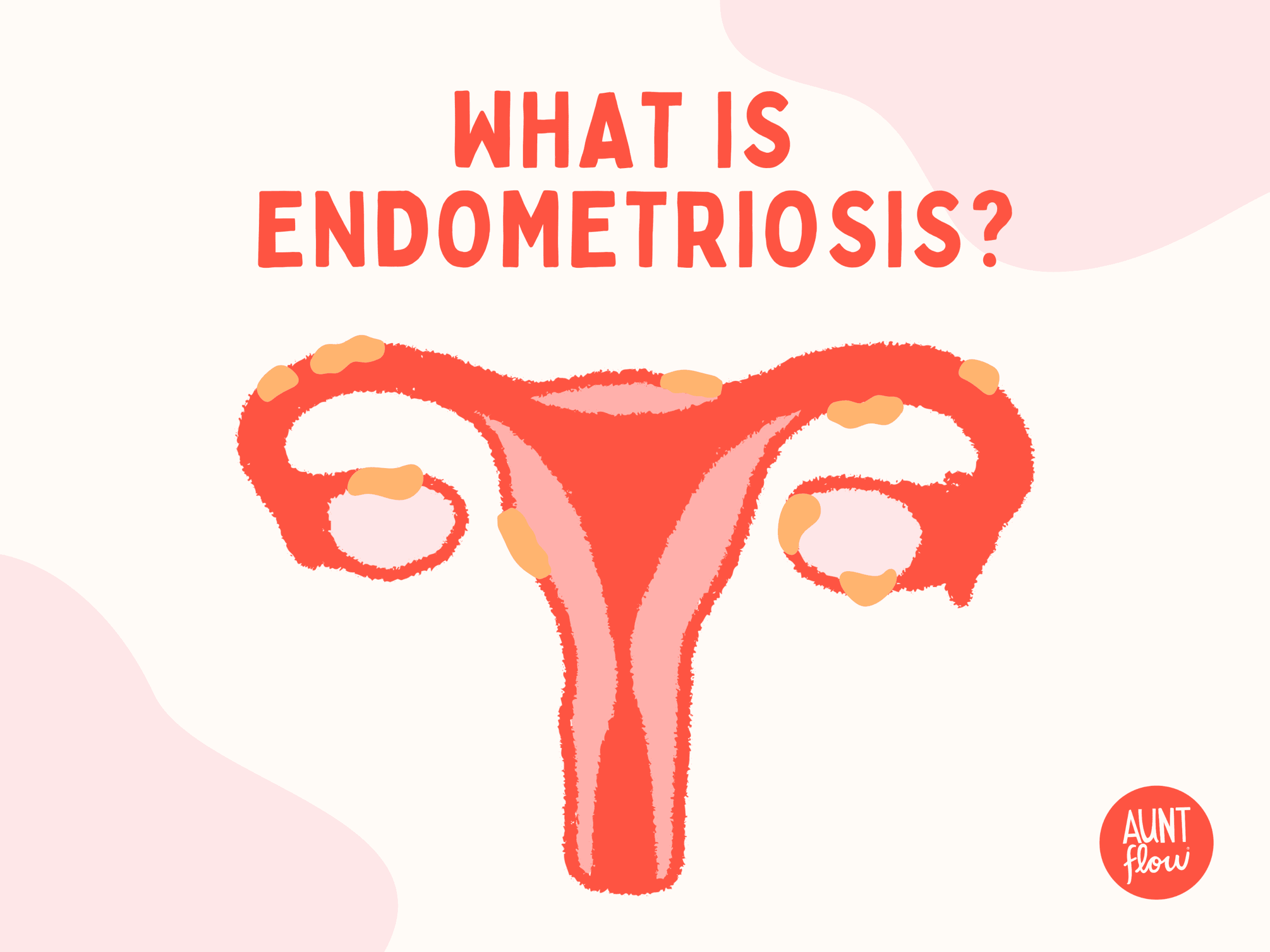
March is Endometriosis Awareness Month. But what is endometriosis? It’s a condition that, according to the American College of Obstetricians and Gynecologists (ACOG), affects around 1 in 10 women of reproductive age worldwide and can cause painful periods, pelvic pain, and other symptoms. Diagnosis delay remains significant, often averaging around 7 years globally.
What Causes Endometriosis?
The exact causes of endometriosis are not fully understood, but experts describe it as a multifactorial condition, meaning multiple biological processes likely contribute to its development and progression.
Endometriosis happens when tissue similar to the inner lining of the uterus (the endometrium) grows outside the uterus, most commonly on the ovaries, fallopian tubes, and the peritoneum, but can also spread to the bowels or the bladder.
This tissue behaves like the uterine lining: it thickens, breaks down, responds to hormonal shifts, and can bleed with your menstrual cycle.
But unlike a period, that blood has nowhere to go. Over time, this can cause:
- Inflammation
- Scar tissue
- Ovarian cysts called endometriomas
- Pelvic pain and other symptoms
Major organizations describe endometriosis as multifactorial, meaning multiple biological processes likely contribute to its development and progression.
Commonly discussed theories about its origin include:
- Retrograde menstruation: Menstrual blood flows backward through the fallopian tubes into the pelvis instead of leaving the body, potentially allowing endometrial-like cells to implant there.
- Coelomic metaplasia: Cells outside the uterus may transform into endometrial-like cells under specific biological triggers.
- Immune and hormonal factors: Altered immune responses and estrogen activity appear to play a role in how lesions implant and persist.
- Genetic predisposition: Endometriosis can run in families. Having a first-degree relative (such as a mother or sister) with endometriosis increases risk. Studies suggest the risk may be approximately 7-10 times higher in first-degree relatives compared to the general population.
How Is Endometriosis Diagnosed?
Endometriosis diagnosis is a clinical process; there is currently no single blood test that confirms endometriosis.
Diagnosis is usually based on a combination of:
- Medical history
- Physical examination
- Imaging
- Sometimes surgery
1. Medical History
An OB-GYN will typically ask about:
- Pain patterns, especially during periods
- Pain with sexual intercourse (dyspareunia, particularly deep)
- Pain with bowel movements (dyschezia) or urination (dysuria), especially around menstruation
- Bleeding patterns, including heavy menstrual bleeding or bleeding between periods
- Severity of menstrual cramps
- What relieves or worsens the pain
- Whether symptoms interfere with daily activities
2. Physical Exam
An internal pelvic exam (also called a bimanual examination) involves the clinician gently inserting one or two gloved fingers into the vagina while the other hand presses lightly on the lower abdomen. This allows them to feel the pelvic organs between both hands.
It may be performed to assess:
- The position and size of pelvic structures (such as the uterus and ovaries)
- Areas of tenderness
- Possible masses or cysts
3. Imaging
Several imaging techniques can further assist in the diagnostic process.
Ultrasounds
- Abdominal ultrasound (over the abdomen)
- Transvaginal ultrasound (covered probe inserted into the vagina): especially useful for identifying ovarian cysts called endometriomas.
MRI
MRI may be used to better evaluate:
- Deep infiltrating endometriosis
- Lesion size and location
- Possible bowel or bladder involvement
- Some specialized centers may use intravenous contrast or bowel preparation to improve visualization in complex cases, but this depends on the clinical situation and is not required for everyone.
Important disclaimer: A normal ultrasound or MRI does not completely rule out endometriosis. Clinicians interpret imaging findings in the context of the full clinical picture.
4. Surgical Diagnosis (Laparoscopy)
Currently, the only way to confirm endometriosis with certainty is through laparoscopy, a minimally invasive (“keyhole”) surgery performed under general anesthesia.
During a laparoscopy:
- The surgeon visualizes suspicious lesions
- A biopsy may be taken
- Tissue is examined under a microscope for confirmation
The surgeon may also remove (excise) visible lesions during the same procedure, which may help improve pain or fertility outcomes in selected patients.
However, surgery is not required for everyone to begin treatment. If symptoms and examination strongly suggest endometriosis, many clinicians initiate treatment based on clinical suspicion to manage symptoms.
Signs and Symptoms of Endometriosis
Diagnosis can be complex, and delays are unfortunately common.
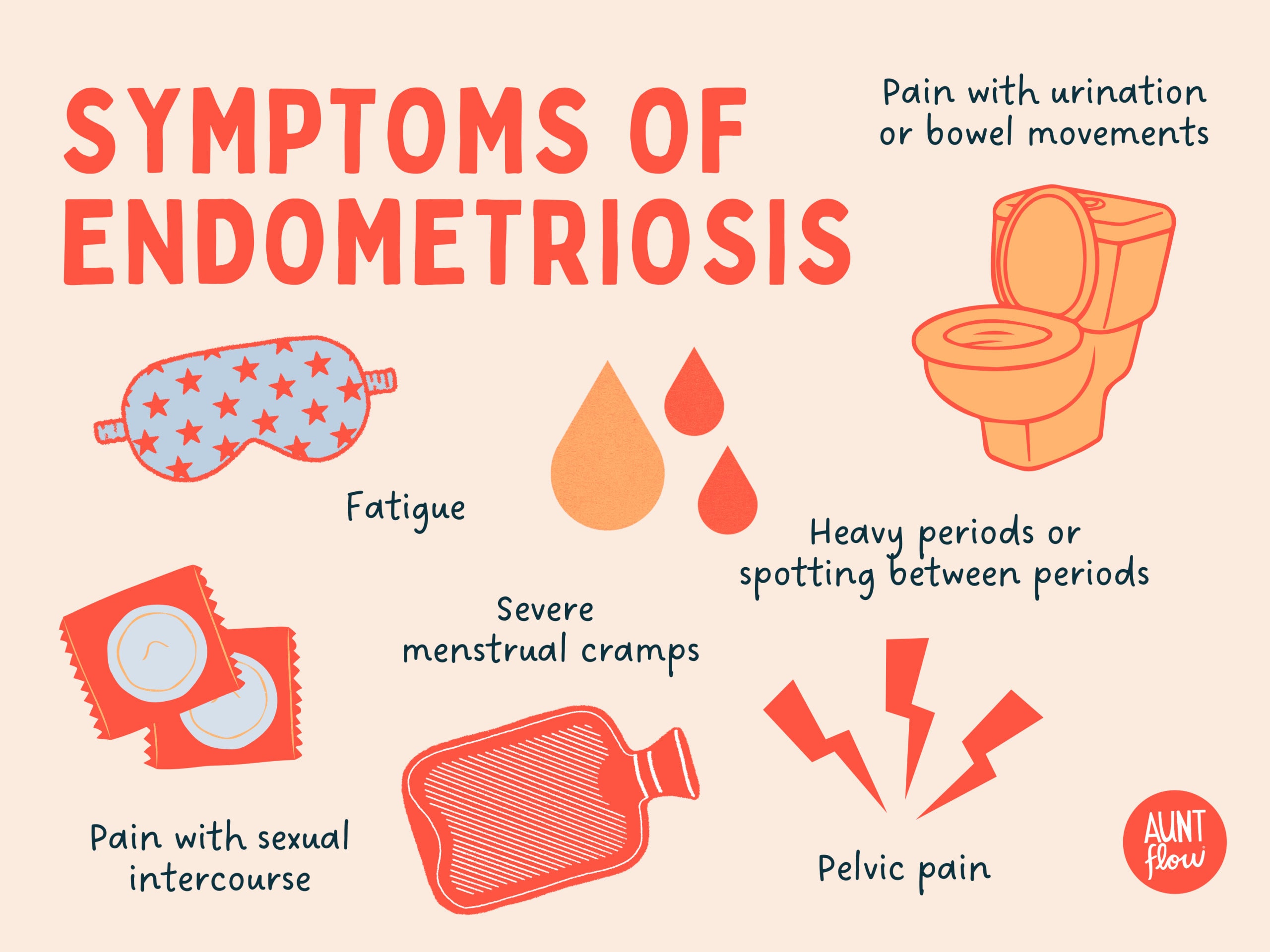
The symptoms of endometriosis can vary from person to person, and there is no single straightforward answer. However, OB-GYNs will typically consider endometriosis as a potential diagnosis when someone reports the following signs of endometriosis:
- Severe menstrual cramps that interfere with daily activities
- Pelvic pain before, during, or outside of periods
- Pain with sexual intercourse (dyspareunia)
- Pain with bowel movements (dyschezia) or urination (dysuria), especially around menstruation
- Heavy menstrual bleeding or bleeding between periods
- Pain that does not improve with standard over-the-counter medications
Important to know:
- Some people have severe pain with minimal visible endometriosis. Others have more extensive endometriosis with milder or even absent symptoms → Symptom severity does not always match disease stage.
- Endometriosis is NOT the only cause of menstrual pain. Other conditions can produce similar symptoms, which is why evaluation by a trained clinician is crucial.
When to See a Doctor for Endometriosis Symptoms
If you suspect something isn’t quite right with your periods or are worried about your symptoms:
- You can seek evaluation from a clinician experienced in menstrual health (often an OB-GYN).
- Keep a symptom journal tracking:
- Timing of symptoms (according to cycle, time of the day),
- For pain-related symptoms (ex. cramps) → note Intensity, onset, recurrence, location
- Bleeding patterns (how often you change your pad/tampon, do you ever bleed through)
- Bowel/urinary/intercourse-related symptoms
- Impact on your daily routine
Doctors often find this information extremely helpful.
Understanding what endometriosis is, along with its symptoms, causes, and diagnosis, can help you advocate for your health. If something feels off with your cycle, trust your body and seek care—you deserve answers.
Remember: If you are dealing with painful periods, you are not alone. 💛
References
- American College of Obstetricians and Gynecologists. Endometriosis. Washington (DC): ACOG; [cited 2026 Mar 20]. Available from: https://www.acog.org/womens-health/faqs/endometriosis
- National Institute of Child Health and Human Development. Endometriosis. Bethesda (MD): NICHD; [cited 2026 Mar 20]. Available from: https://www.nichd.nih.gov/health/topics/factsheets/endometriosis
- Mayo Clinic. Endometriosis: Diagnosis and treatment. Mayo Clinic; [cited 2026 Mar 20]. Available from: https://www.mayoclinic.org/diseases-conditions/endometriosis/diagnosis-treatment/drc-20354661
- European Society of Human Reproduction and Embryology (ESHRE). Endometriosis guideline. [cited 2026 Mar 20]. Available from: https://www.eshre.eu/guideline/endometriosis
- Endometriosis UK. Getting diagnosed. [cited 2026 Mar 20]. Available from: https://www.endometriosis-uk.org/getting-diagnosed-0
- Zondervan KT, Becker CM, Missmer SA. Endometriosis. N Engl J Med. 2020;382:1244–1256. doi:10.1056/NEJMra1810764.
- Nouri M, Ott J, Krupitz B, Huber JC, Wenzl R. Family incidence of endometriosis in first-, second-, and third-degree relatives: case-control study. Reprod Biol Endocrinol. 2010;8:85. doi:10.1186/1477-7827-8-85.
- Bazot M, Bharwani N, Huchon C, Kinkel K, Cunha TM, Guerra A, et al. European society of urogenital radiology (ESUR) guidelines: MR imaging of pelvic endometriosis. Eur Radiol. 2016;27(7):2765–2775. doi:10.1007/s00330-016-4673-z.