

Original article written by Assistant Director of Advancement Communications Jill Graziano Laiacona
Senior Martina Nicholson has spent the last year stocking free menstrual products in baskets in public bathrooms at the University of Mary Washington. The tampons and pads are tiny enough to fit in a purse or pocket, yet they’ve made a significant impact on her fellow students.
I’ve never needed to worry about where my next tampon or pad is coming from, but it’s a concern for so many people.
Martina Nicholson
The Fund for Mary Washington Impact Grant that Martina received this spring helped her purchase four Aunt Flow dispensers and enough products to last the campus for the next year. Sleek, shiny, and silver – and easily accessible for those with visual or physical impairments – the dispensers were installed over the summer in high-traffic buildings like the Cedric Rucker University Center, the Eagle’s Nest, the Hurley Convergence Center, and the UMW Fitness Center.
Piloted by Mary Washington’s Office of Advancement and Alumni Engagement, the inaugural Impact Grant program awarded $25,000 in donor-funded grants, ranging from $1,200 to $5,000, to eight projects or initiatives pitched by students, faculty, and staff on behalf of recognized campus organizations. Applications for 2025 Impact Grants will open in the spring.
“It helped us achieve a long-term goal in such a short period of time,” said Martina, a double major in communications and digital studies and philosophy: pre-law, who learned about period poverty through the Women’s, Gender, and Sexuality Studies Student Association.
After consulting with Dean of Students Melissa Jones and Facilities Operations, her original plan was to place 10 baskets with donated period products across campus, which she and other students maintained using funding from the UMW Finance Committee.
But Martina felt that her project was taking away from other student activities and wanted to find a more sustainable solution. That’s how the Impact Grant program came into play. She and her classmates crafted a proposal, “Preventing Period Poverty,” which she pitched in April to a committee composed of the Alumni Association Board of Directors and Young Alumni Council.
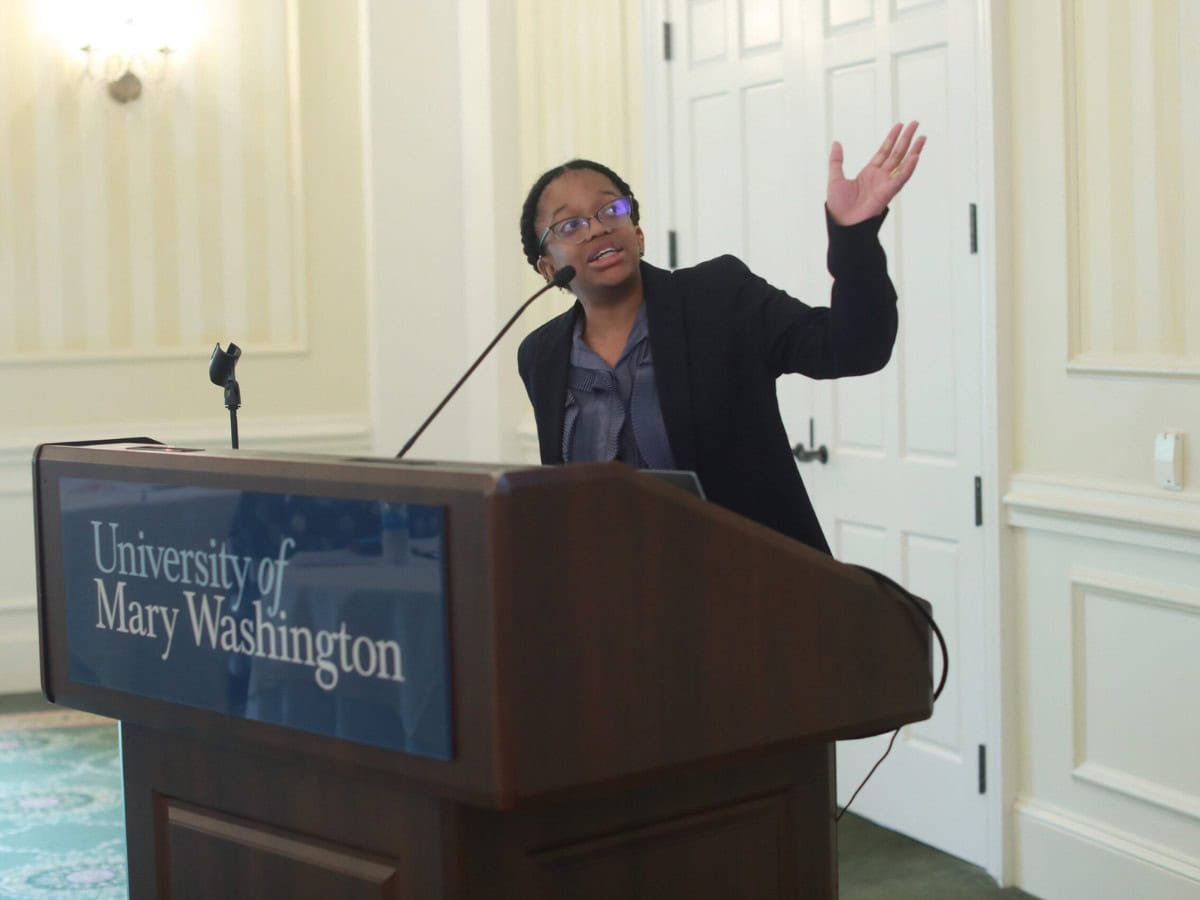
“I had never applied for a grant before, but I realized that passion was all that it takes,” said Martina, who encouraged UMW faculty and staff to ask her probing questions so she could prepare. With plans to work for a nonprofit before going to law school, she said the experience improved her writing, research, and public speaking skills. “Taking a simple idea and seeing it to fruition was so valuable.”
Her presentation helped her secure funding totaling $4,000, covering the cost of not only the dispensers but 4,000 tampons and 4,000 pads, which Aunt Flow provided at a discounted price. Every machine can hold 50 of each menstrual product, twice the amount her baskets could hold, and includes Braille for visually impaired students.

As a commuter student, junior Tonia Attie said she feels relieved knowing that she can grab a pad or tampon if she doesn’t have one in her bag. “And these products are often expensive, so getting them for free in an easy-to-reach location is truly helpful.”
Recent graduate Eliana Nachman ’24 said having the Aunt Flow dispensers on campus supports students while reducing the stigma around periods.
I think it’s integral to ensuring that UMW continues to be an environment that prioritizes accessibility for its students. Martina has helped foster a culture of acceptance around Mary Washington, one that is warmly welcomed.
Sophomore Caty Taylor
Martina Nicholson has received the Marjorie Jean Frost ’44, Sylvia McJilton Woodcock ’61, and Dr. George Van Sant scholarships and the Penelope Ann Parrish Internship in Journalism. She was also named the 2025 recipient of the Grace Mann Launch Award.