

Original article written by Laila Casiano, The Herald at Arkansas State University
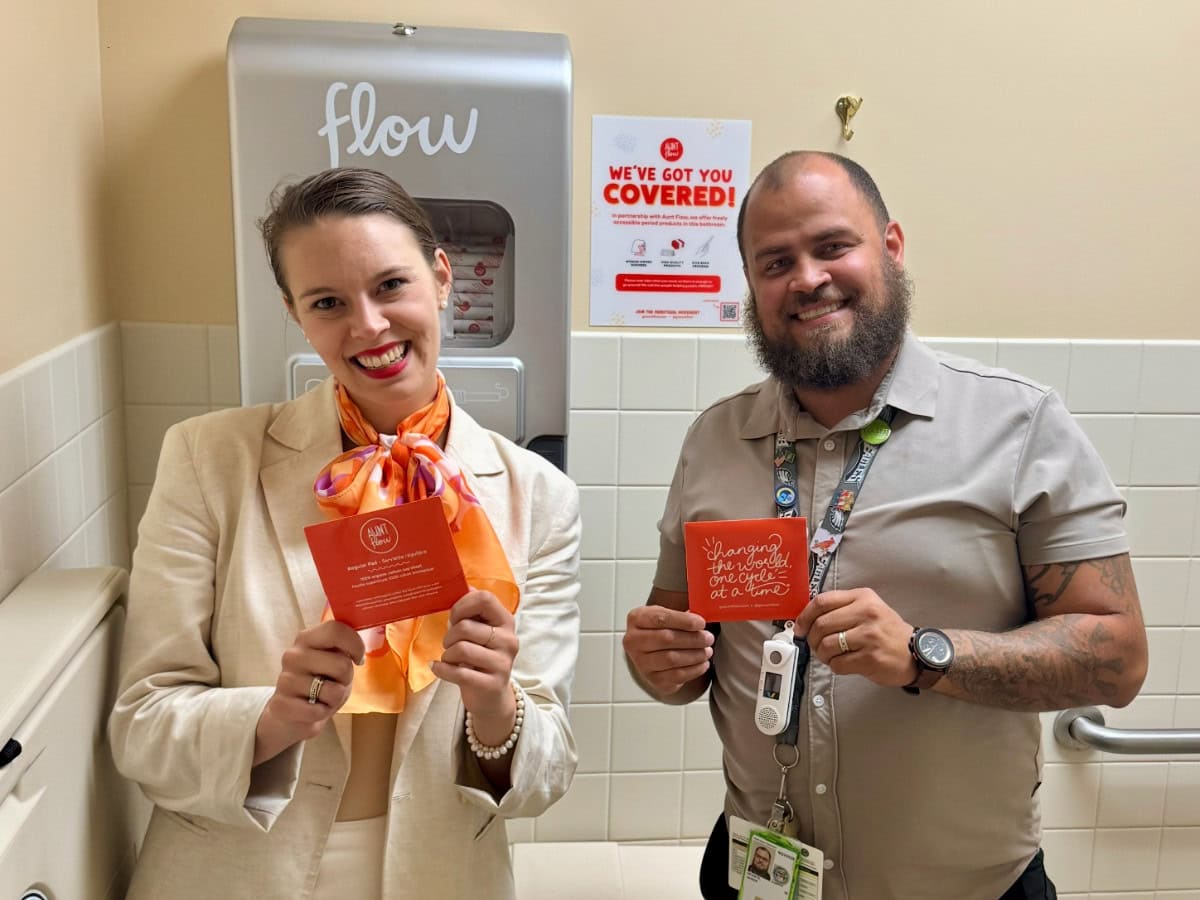
When Claire Coder founded Aunt Flow at 18 years old, her goal was simple: make period products accessible and free in public spaces. Now, Arkansas State University is joining the mission by installing dispensers at the College of Liberal Arts and Communication (CLAC).
Since its founding, Aunt Flow has partnered with hundreds of schools and businesses—including Apple, Meta, Google, Versace, Lego, Princeton University, and Netflix—to offer free and accessible menstrual product dispensers within their facilities and to educate and normalize menstruation.
Ensuring Student Success
By joining Aunt Flow’s mission, CLAC aims to promote menstrual equity and advance awareness of the menstrual movement on campus.
We want to do whatever is necessary to help all students be successful while they’re at Arkansas State University and in the College of Liberal Arts and Communication, and if this is one small way to do that, then we’re happy to do it.
Cherisse Jones-Branch, Ph.D., Dean of Liberal Arts and Communication
Jones-Branch said that, with the help of her staff, they coordinated with Aunt Flow to provide menstrual products for their students.
Alleviating Student Financial Burdens
She said there has been a significant demand among the student body for free and accessible products, adding it was important for the dean’s office to alleviate financial burdens for students.
“It is important,” Jones-Branch said. “I know that those items are expensive and people are in college, they have other expenses and they’re trying to hold it together as best they can.”
The dean also said providing resources like menstrual products aligns with A-State’s mission to support students and help them succeed.
There are young women all over this campus who need those items and for whom they may very well be cost-prohibitive. This is our one way of helping them deal with that expense.
Jones-Branch
She said she hopes this initiative will educate the campus community about menstrual equity and period poverty.
“I think as the landscape of higher education changes, we need to be looking at all of our student needs,” Jones-Branch said. “These things are very real issues, and we can’t wish them away.”
Additionally, she said that addressing such issues supports the ultimate goal of helping students graduate.
“College students, as a rule, don’t have tons of money. We don’t want there to be any barriers to them graduating because they can’t afford basic items,” Jones-Branch said.
Aunt Flow x Arkansas State
Aunt Flow Account Executive Team Manager Genevieve Jaser serves as Arkansas State’s main point of contact for the school’s period program. She said the collaboration between CLAC and Aunt Flow began in December 2024.
When we are first starting to work with someone, it’s really identifying the need. How can we support them in the process of implementing a period program? Then, of course, make sure they have what they need and that they feel comfortable and confident advocating for this with their teams and speaking about this on campus.
Genevieve Jaser
Aunt Flow products are ADA-compliant, freely accessible and made from organic cotton. Jaser said these qualities represent significant strides toward menstrual equity.
Shedding the Stigma Through Increased Access
Beyond providing products, Aunt Flow seeks to dismantle the stigma surrounding menstruation. Jaser said the simplest and most effective way to address it is by talking openly about menstruation.
“I think for a long time, not talking about it has helped keep menstruation as this dirty and scary thing that can’t be discussed,” Jaser said. “And that has led to gaps right in the bathroom experience, for women and people with periods, and generally speaking, in the greater society.”
Additionally, Jaser said social inequities have perpetuated the lack of attention to menstrual health and access to free period products in public and institutional places.
“If we zoom in a little bit, this becomes really an issue of women and men, and how, for so long, the bathroom experience was designed around non-menstruators. If you don’t get your period, you have everything you need. If you do get your period, you don’t have what you need,” Jaser said. “I think the thoughtfulness and the necessity of this has been neglected for a long time.”
Jaser said she is currently working with the Assistant Dean of Students and Director of Student Union events, Alexis Hurdle Besharse, regarding campus-wide support. Hoping to have dispensers and resources available in different departments and colleges on campus.
Fighting Period Poverty on Campus
Other initiatives have been created on campus to address period poverty, including the A-State food pantry, which provides free sanitary and hygienic products.
Allison Webber, a sophomore nursing major from Highland, Arkansas, is the food recovery director for the A-State Food Pantry. She said it’s awesome to have period products available on campus.
“I feel like period products specifically are so incredibly expensive,” Webber said. “For people that don’t even have access to a car, they’d have to wait for the bus to come and take them to a store to pay for menstrual products.”
Webber said it can also be a lifesaver for women who are going to class and may not have any menstrual products with them.
“One of my favorite things to do is when somebody asks me, ‘Hey, do you have a tampon?’ I’m like, ‘Yeah, girl!’ I love that, it just makes me feel so much better. So I think that’s an awesome resource,” Webber said.
By partnering with Aunt Flow, A-State not only meets students’ practical needs but also champions a movement toward equity and inclusivity within higher education.
If one student feels there’s a need for this, they are certainly not alone. And I guarantee you there are dozens more on campus that have thought the same thing. Creating and being within a community where this is talked about and celebrated; don’t be afraid if you think you’re going to be the first person to start talking about your period and about menstrual equity.
Genevieve Jaser